
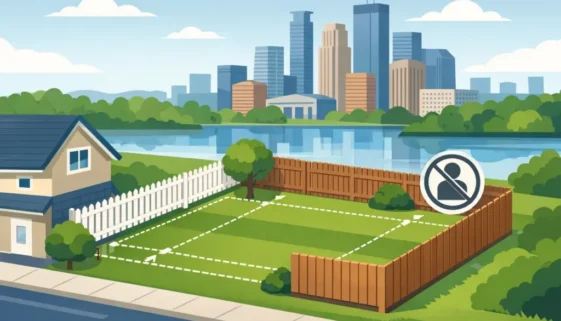
Fence Setback Rules for Twin Cities Properties
A fence can look perfectly placed from the yard and still create a costly problem if it crosses a property line, blocks sight distance, or sits in an easement. Fence setback rules are not a one-size-fits-all measurement, especially across Minneapolis, St. Paul, and surrounding Twin Cities communities. Before posts go in the ground, property owners need to confirm the rules that apply to their lot, their fence design, and their planned gate locations.
For a homeowner, this step protects a new investment in privacy and curb appeal. For a commercial or industrial property, it helps prevent conflicts that can delay security improvements, access-control projects, or site operations. A careful review before installation is almost always easier than moving a finished fence afterward.
What Fence Setback Rules Actually Control
Fence setbacks describe how close a fence may be installed to a property line, street, sidewalk, alley, corner, drainage area, or other regulated part of a site. The term is sometimes used broadly, but the specific restriction may come from a zoning ordinance, right-of-way requirement, subdivision agreement, utility easement, or homeowners association rule.
Many property owners assume a fence can be built directly on the property line. That may be allowed in some situations, but it is not automatic. A municipality may require a fence to sit inside the lot in certain locations, and a shared boundary fence can create questions about maintenance, ownership, and access even when its placement is permitted.
The rules often change depending on where the fence sits. A rear-yard privacy fence may be treated differently from a fence along a front yard, driveway, side street, parking area, or commercial entrance. Height, opacity, materials, and whether the fence includes a gate can also affect what is allowed.
Start With the Actual Property Line
A plat map, online parcel image, old landscape feature, or existing fence is not always enough to establish a legal boundary. Over time, fences get replaced, yards are graded, and neighbors make improvements based on assumptions. An existing fence may be several feet inside a lot, may sit over the line, or may have been installed before current rules were adopted.
When the precise boundary matters, a current survey is the strongest starting point. Survey markers and a documented property survey help establish where the fence can be planned with confidence. This is particularly valuable on narrow urban lots, irregularly shaped properties, homes with alleys, and commercial sites where every foot affects parking, loading, or building access.
If you are installing near a neighbor’s boundary, it is smart to discuss the plan before work begins. A straightforward conversation can prevent surprises later, particularly when one side of the fence will face a neighboring property or when access is needed to complete installation and future maintenance.
Do Not Confuse the Property Line With the Right-of-Way
The area between a home and a street can be more complicated than it appears. The public right-of-way may extend beyond the curb or sidewalk and into what feels like a front lawn. Fences, landscaping, signs, and gates located in that area may be limited or prohibited even though the space is maintained by the adjacent property owner.
Alleys raise similar issues. A backyard fence near an alley may need to account for utility access, vehicle clearance, snow removal, or municipal requirements. On commercial properties, the same principle can apply around drive lanes, fire access routes, sidewalks, and site entrances.
Corner Lots Need Extra Attention
Corner lots are one of the most common places where fence placement becomes more restricted. Municipalities often require a clear sight triangle near intersections, driveways, or alleys so drivers, cyclists, and pedestrians can see approaching traffic. A tall solid fence, dense hedge, gate, or decorative feature can create a visibility hazard where two streets meet.
The exact size of a required clear-vision area and the maximum allowed height vary by city and by the type of intersection. That is why a fence layout that works on an interior lot may not work on a corner property. Do not rely on a neighbor’s fence as proof that the same design will be approved today.
This does not mean corner-lot owners must give up privacy altogether. It may mean adjusting the start point, stepping down the fence height near the corner, selecting a more open ornamental style in a limited area, or moving solid screening farther back into the yard. A well-planned layout can preserve security and appearance while respecting visibility requirements.
Easements Can Limit Where Posts Go
An easement gives a utility company, government agency, neighbor, or other party the right to use a portion of private property for a defined purpose. Utility easements are common along lot lines and rear yards. Drainage easements may run through residential developments, while access easements can be common on commercial and industrial sites.
A fence installed within an easement may be allowed, restricted, or permitted only with the understanding that it may need to be removed if access is required. If a utility crew needs to repair underground equipment, the property owner may be responsible for the cost of removing and reinstalling a fence. A fence that blocks access to equipment can also create an immediate operational issue.
Before choosing a layout, review the survey and development documents for recorded easements. Then confirm utility locations through the appropriate utility-marking process before digging. Marked utilities do not replace a survey or confirm setback compliance, but they are essential for safe post installation.
Permits, Height Limits, and HOA Requirements
Fence setback rules usually work alongside other local requirements. A city may regulate fence height differently in front, side, and rear yards. It may require a permit above a certain height, limit solid fencing in a front yard, or set standards for gates near sidewalks and public access areas.
Homeowners association rules can be more restrictive than city requirements. An HOA may control approved materials, colors, heights, styles, and placement. Some associations require written approval before installation, including for a fence that is otherwise compliant with municipal code.
Commercial and industrial projects may involve additional review. Security fencing, ornamental perimeter fencing, chain-link enclosures, dumpster screening, and automated gates can affect fire access, traffic flow, accessibility, stormwater systems, and emergency response. Gate location deserves particular attention. A gate should not swing into a public sidewalk, block a drive aisle, or leave vehicles waiting in a traffic lane while access is controlled.
A Practical Way to Plan Fence Placement
The best fence projects begin with the site rather than the product. First, identify the intended purpose: privacy, pet containment, pool safety, perimeter security, access control, or curb appeal. Then map the areas where the fence needs to perform that job without interfering with property access, utilities, visibility, or local requirements.
Next, confirm the property line and review the relevant city, county, and association rules. If the fence will be close to a street, corner, alley, shared boundary, or easement, build extra time into the planning process. These are the locations where a small design adjustment can avoid a major correction later.
Finally, select a fence style that fits both the property and the rules. Wood and vinyl can provide strong privacy where solid screening is allowed. Ornamental fencing can define a front boundary while maintaining a more open appearance. Chain-link fencing can be an efficient choice for secure enclosures, athletic areas, commercial sites, and industrial perimeters. The right material depends on the location, required durability, desired appearance, and level of access control.
Why Professional Layout Matters
A fence installation is more than setting posts at an even distance. Proper layout considers grades, drainage, boundary conditions, gate clearances, utility conflicts, and the visual line of the finished project. On sloped sites, placement decisions can affect whether gaps appear under the fence or whether the panels follow the terrain cleanly.
For automated gates, accurate placement is even more critical. The gate operator, vehicle approach, safety devices, power needs, and emergency access all need room to function correctly. A gate that looks good on a sketch can be inconvenient or unsafe if it is positioned without regard for the site’s real traffic patterns.
Boulevard Fence helps Twin Cities property owners plan durable fencing solutions around the practical details that matter before installation starts. A site review and clear project scope can help identify placement concerns early, whether the project involves a backyard privacy fence, commercial perimeter fencing, or an access-control gate.
Local rules can change, and each property has its own conditions. Before committing to a fence line, take the time to verify setbacks, boundaries, easements, and approval requirements. That preparation gives your new fence the best chance to deliver lasting security, privacy, and curb appeal exactly where it belongs.