

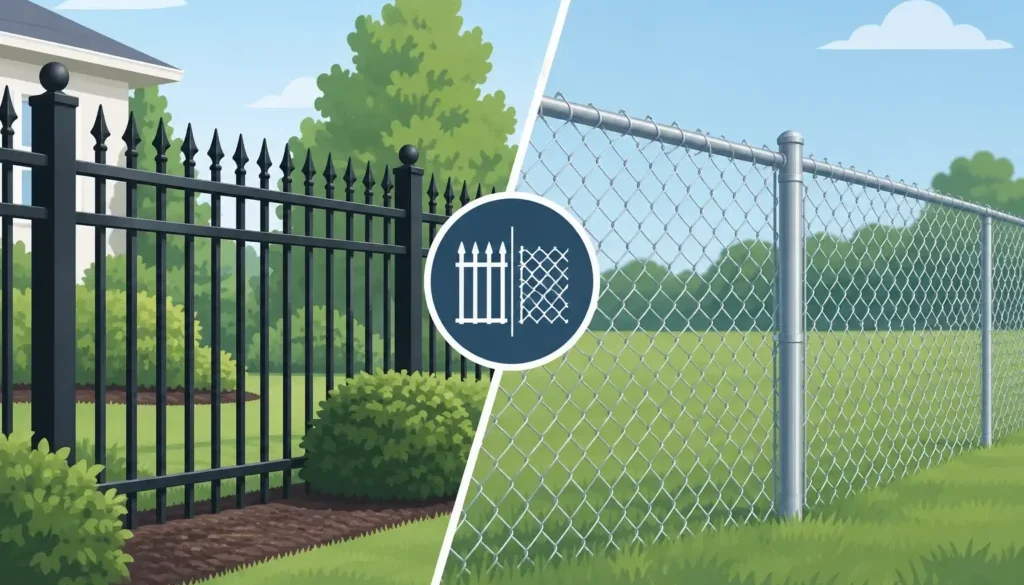
A fence has to do more than mark a property line. For Twin Cities homeowners, businesses, and facility managers, the choice between an ornamental fence vs chain link often comes down to the daily demands placed on the perimeter: appearance, access control, security, budget, and long-term maintenance. Both are proven fencing systems, but they create very different results.
Chain link is a practical workhorse. Ornamental fencing makes a stronger architectural statement while still providing dependable protection. The right choice depends on what the fence needs to accomplish and how prominently it will be seen.
Ornamental Fence vs Chain Link: Start With the Job
The first question is not which fence looks better. It is what needs protection. A backyard pool area, a front-facing commercial property, a warehouse yard, a school perimeter, and a dog run all have different priorities. Selecting a fence based only on the initial price or a photo can lead to a system that does not serve the property well over time.
Ornamental fencing is usually the better fit when professional appearance and visible curb appeal matter. Its clean vertical pickets and rails offer a polished, open look that works especially well around homes, offices, apartments, retail sites, churches, parks, and managed communities. It defines a boundary without making the property feel closed off.
Chain link is commonly selected for larger perimeters, utility areas, construction sites, athletic facilities, industrial properties, and locations where containment is the primary goal. It is efficient to install, highly versatile, and available in a range of heights and configurations. For many functional applications, it delivers excellent value.
Appearance and Property Value
Ornamental fencing is designed to be seen. A black ornamental fence can frame landscaping, complement masonry or siding, and give a property a finished look from the street. Because it has an open design, it preserves views and allows light through while creating a clear visual boundary. For homeowners, that can improve curb appeal without the solid presence of a privacy fence.
For commercial properties, appearance affects more than first impressions. A clean, well-designed perimeter can support a professional image for customers, tenants, and visitors. Ornamental fencing is often a strong choice at building entrances, parking areas, walkways, outdoor amenity spaces, and front-facing property lines.
Chain link has a more utilitarian appearance. Galvanized chain link is familiar, functional, and straightforward. Black or green vinyl-coated chain link can soften its visual impact and help it blend into a residential yard or landscaped commercial site. Still, it typically does not provide the same upscale presentation as ornamental fencing.
That difference does not make chain link the wrong option. A fence around a rear service yard or a large equipment storage area may not need decorative detail. Spending more on ornamental materials in a low-visibility, high-function area may not be the best use of the project budget.
Security, Containment, and Access Control
Both fence types can create a secure perimeter when they are properly designed and installed. Height, gate placement, post depth, material gauge, and site conditions all influence performance. A well-built fence system should be evaluated as a whole, not just by the panel or fabric selected.
Chain link is exceptionally adaptable for security and containment. It can be installed at a range of heights and can be paired with privacy slats, windscreens, barbed wire where appropriate, or other security features for commercial and industrial applications. Its flexible layout also makes it practical for long runs, uneven terrain, and large sites.
Ornamental fencing offers strong security with a more refined profile. Closely spaced pickets and rackable panels can create a controlled perimeter without obscuring the property. Depending on the system, pointed picket tops may add a visual deterrent, while flat-top designs provide a cleaner look for residential settings and family-friendly environments.
Gates deserve the same planning as the fence itself. A walk gate may be enough for a residential side yard, while a commercial lot may require a cantilever slide gate, swing gate, or automated entry system. For properties that need scheduled access, credentialed entry, or reliable vehicle control, gate operators can turn the perimeter into an organized access point rather than a weak spot.
Cost: Initial Investment and Long-Term Value
Chain link is generally the more budget-friendly option, particularly for long perimeter runs. Its materials and installation method make it a practical choice when coverage is the priority. This is one reason it remains common at industrial facilities, ball fields, dog parks, storage areas, and large residential yards.
Ornamental fencing typically carries a higher initial cost because of its materials, fabrication, and finished appearance. However, a higher upfront investment can make sense when the fence is a visible part of the property, when curb appeal supports the property’s value, or when a lower-profile commercial site needs to present a more polished image.
The lowest bid is not always the lowest long-term cost. Posts that are not properly set, gates that are poorly aligned, and undersized materials can create repair costs and frustration regardless of fence type. A detailed estimate should account for the fence layout, slope, gate requirements, demolition of existing fencing, and any special site conditions that affect installation.
In the Twin Cities, weather also belongs in the value discussion. Freeze-thaw cycles, snow storage, road salt near parking areas, and seasonal ground movement put stress on every exterior structure. Quality materials and accurate installation help a fence remain straight, secure, and dependable through changing conditions.
Maintenance and Durability
Both chain link and ornamental fence systems are low-maintenance when quality coated or galvanized materials are used. Neither requires the regular staining and sealing associated with many wood fences. That makes both options attractive for busy homeowners and property managers who need dependable performance without constant upkeep.
Chain link fencing benefits from periodic inspections of fabric tension, gate hardware, terminal posts, and areas exposed to lawn equipment or vehicle traffic. Galvanized finishes resist corrosion, while vinyl-coated options add color and an additional protective layer. If a section is damaged, repairs are often direct and cost-effective.
Ornamental fencing should also be inspected periodically, especially around gates, fasteners, and any areas where the finish has been scratched by impact or maintenance equipment. Quality powder-coated finishes are built for exterior exposure and retain a clean appearance with basic cleaning and occasional touch-up attention.
Neither fence is maintenance-free. The practical difference is that ornamental fencing often retains a more finished look with minimal care, while chain link is easier to adapt and repair across a large functional perimeter.
Privacy and Visibility
If complete privacy is the main goal, neither standard ornamental fence nor standard chain link provides it on its own. Ornamental pickets are intentionally open, and chain link fabric allows clear visibility through the fence. A wood or vinyl privacy fence may be the better starting point for a backyard that needs a visual screen from neighbors or traffic.
Still, chain link can be enhanced with privacy slats or screening where partial visual separation is needed. This can work well for a utility area, tennis court, dumpster enclosure, or temporary screening need. The trade-off is that added screening can catch wind, affect the look of the fence, and require maintenance over time.
Ornamental fencing is often selected because visibility is an advantage. It allows a homeowner to keep an eye on a pool area or pets, and it allows businesses to maintain natural surveillance around entrances and parking lots. Open visibility can support security when it keeps hiding places to a minimum.
Choosing for Residential, Commercial, and Industrial Sites
For a residential front yard, pool enclosure, garden boundary, or visible side yard, ornamental fencing is often worth serious consideration. It provides security and definition while contributing to the home’s overall appearance. Chain link can be the smarter residential choice for large backyards, pet enclosures, and budget-conscious projects where function takes priority.
Commercial properties often benefit from using both. Ornamental fencing can define the front entrance, customer-facing parking areas, or office perimeter. Chain link can secure loading zones, equipment yards, rear service areas, and long property boundaries. Matching each fence type to its job creates a better-performing project than forcing one material across every area.
Industrial facilities commonly prioritize chain link for perimeter length, containment, and adaptable security options. But ornamental fencing may be appropriate at the main entrance or administrative building where the property needs to balance site control with a professional presentation.
A fence is a long-term part of the property, so the decision deserves more than a quick material comparison. Boulevard Fence can evaluate the layout, intended use, gate needs, and visual goals to recommend a fence system built for the way your property operates. A free estimate is a practical next step toward a perimeter that looks right, performs reliably, and holds up over time.


