

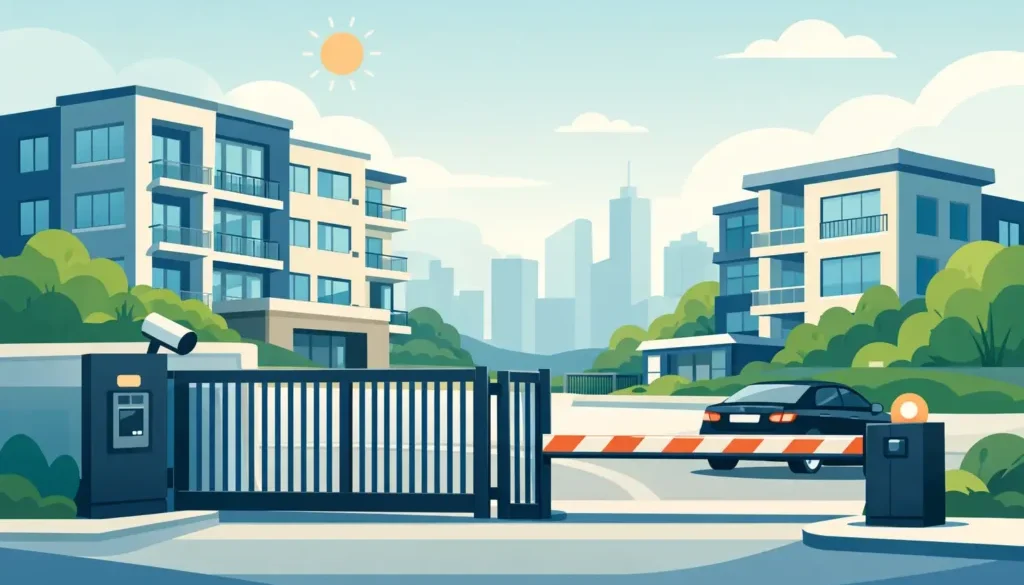
An apartment gate has to handle far more than an occasional visitor. It may open hundreds of times a day for residents, delivery drivers, maintenance crews, emergency responders, and waste haulers. The best gates for apartment complexes balance dependable access with perimeter security, while fitting the traffic patterns and appearance of the property.
For Twin Cities property managers, that decision also has to account for snow, ice, freeze-thaw cycles, and the wear that comes with a busy multi-family site. A gate that looks good on day one but binds, sags, or creates traffic backups is not a long-term solution. The right system starts with the gate style, but it also depends on proper layout, heavy-duty construction, and an access plan that works for residents and staff.
What Makes a Gate Right for an Apartment Property?
The right gate is not always the most expensive or the most elaborate. It is the one designed around the entrance it protects. Before selecting materials or an operator, property owners should consider how many vehicles use the entrance, the available driveway width, where vehicles can wait safely, and whether the gate will secure a parking lot, garage entrance, pool area, pedestrian path, or the entire property.
Traffic volume matters most. A small apartment building with a limited parking area may work well with a single swing gate and keypad entry. A larger complex with continuous traffic needs a faster, more durable system that does not leave cars stacked in the street. The gate should provide a clear point of entry without becoming a daily frustration for residents.
Appearance matters, too. Gates are one of the first features prospective residents see. Ornamental steel or aluminum-style fencing can create an upscale, welcoming entrance, while commercial chain link fencing may be the practical choice for a service drive or utility enclosure. The best design often combines secure perimeter fencing with a gate that matches the property architecture.
The Best Gates for Apartment Complexes by Application
Sliding gates for high-traffic entrances
Sliding gates are often the strongest choice for apartment complexes with busy parking lot entrances. Instead of swinging into a drive aisle, the gate travels horizontally along the fence line. This makes it useful where vehicles need room to queue or where a swinging gate would interfere with parking, sidewalks, or traffic flow.
A cantilever sliding gate is particularly well suited to Minnesota conditions. Unlike a traditional track gate, it does not roll along a ground track that can collect snow, ice, gravel, and debris. The gate is supported above the driveway opening, helping it operate more reliably through changing weather. It also gives a property a clean, professional look when paired with ornamental fencing or commercial chain link.
Sliding gates do require sufficient fence-line space for the gate to travel when open. On a tight urban site, that space requirement can rule out a sliding design. A contractor should review the layout before a gate style is selected, not after posts are already installed.
Swing gates for smaller lots and controlled access points
Swing gates remain a practical, attractive option for smaller apartment properties, private parking areas, and secondary entrances. A single-leaf gate works well for narrower openings, while a double swing gate can cover a wider driveway when there is enough clear space for both leaves to open.
This style can be a good fit for properties where traffic is moderate and drivers have room to stop off the street before entering a code or credential. It is also a popular choice for pedestrian-adjacent areas, pool enclosures, courtyards, and maintenance access.
The trade-off is clearance. Swing gates need an unobstructed swing path, and that path must stay workable through snow season. They also need properly sized posts, hinges, and operators to prevent sagging and premature wear. A light residential gate is rarely the right answer for an apartment entrance that will cycle throughout the day.
Vertical lift gates for limited side clearance
Some apartment sites do not have room for a sliding gate to travel or a swing gate to open. In those situations, a vertical lift gate can be worth considering. This style raises upward rather than moving sideways, allowing it to secure a driveway with limited fence-line clearance.
Vertical lift gates are typically used for commercial-level applications and require careful engineering, adequate overhead clearance, and reliable safety equipment. They are not necessary for every property, but they can solve a difficult access problem when conventional styles do not fit.
Pedestrian gates that protect shared amenities
Vehicle gates get most of the attention, but pedestrian gates are just as important at many multi-family properties. They can control access to pools, playgrounds, dog areas, rooftop spaces, bike storage, courtyards, and side entrances. A self-closing, self-latching pedestrian gate is especially valuable around pool areas where code compliance and child safety are priorities.
Pedestrian access should be planned separately from vehicle access whenever possible. Asking residents to walk through an active drive gate is inconvenient and can create avoidable safety concerns. A dedicated pedestrian gate with compatible credential access gives residents a clearer, safer route.
Choose Materials for Security and Long-Term Appearance
For a main apartment entrance, ornamental steel fencing and gates deliver a polished appearance with strong visibility. Property managers can maintain sightlines into parking areas while creating a defined, secure boundary. The open design also avoids the closed-in look that can come with solid privacy fencing at a shared residential property.
Commercial chain link is a dependable option for back-of-property lines, storage areas, service yards, and utility enclosures. It is durable, cost-effective, and available with privacy slats or screening when visual separation is needed. For greater security, the fencing and gate height, fabric gauge, framework, and access hardware should be selected as a complete system rather than as individual parts.
Aluminum-style ornamental systems can offer corrosion resistance and a refined appearance, while steel provides substantial strength for demanding entry points. The best material depends on the purpose of the gate. A decorative courtyard entry has different needs than a heavy-use vehicle gate protecting a resident parking lot.
Access Control Should Match How Residents Actually Enter
A gate operator is only as useful as the access system attached to it. Keypads are familiar and cost-effective, but shared codes can be passed along or become difficult to manage at larger properties. Key fobs, remote controls, card readers, mobile credentials, and video intercoms provide more control and can make it easier to remove access when a resident moves out.
For many apartment complexes, a layered approach works best. Residents may use fobs or mobile access, visitors may use a directory or call box, and vendors may receive temporary codes. Staff should have a dependable override method, while emergency responders need approved access that does not delay service.
Every automated gate should also include the appropriate safety devices. Photo eyes, monitored edges, vehicle detection loops, warning signage, and emergency release features help protect people, vehicles, and the gate itself. These details are not optional add-ons. They are central to safe, reliable gate operation.
Avoid the Most Common Apartment Gate Mistakes
Property managers often run into trouble when a gate is selected before the site is evaluated. A gate may be too narrow for moving trucks, positioned where vehicles block a public street, or paired with an operator that is not rated for the expected number of cycles. Another common issue is underestimating drainage and winter maintenance. Standing water, ice, and snow storage locations can affect gate movement and access equipment.
It is also risky to treat gate installation as a stand-alone purchase. Posts, fencing, operators, safety devices, controls, electrical work, and access management all need to function together. A system installed for the actual site conditions will last longer and require fewer disruptive repairs.
Build an Entrance Residents Can Rely On
A well-designed apartment gate should make the property feel controlled, not complicated. It should protect resident parking and amenities, support efficient daily traffic, and present the building with a professional finish. The right choice may be a cantilever sliding gate for a busy lot, a swing gate for a smaller entrance, or a dedicated pedestrian gate for shared spaces.
Boulevard Fence helps Twin Cities property managers plan and install customized fencing, gates, and gate operator systems built around the way their properties operate. A site-specific consultation can identify the gate style, materials, and access controls that provide dependable protection without creating unnecessary friction for residents.


