
A busy industrial gate can move several times a day without attracting much attention – until it sticks, closes unexpectedly, or allows an unauthorized vehicle through. This industrial gate safety guide helps facility operators, property managers, and contractors focus on the conditions that protect people, equipment, and daily operations.
Industrial gates are not simply perimeter features. They are working access points that must manage vehicle traffic, pedestrian movement, deliveries, security requirements, and weather exposure. A safe gate system begins with the right design and continues with proper installation, clear operating procedures, and regular service.
Start With the Site, Not the Gate
The best industrial gate is selected for how the property actually operates. Before choosing a sliding, swing, cantilever, or vertical-lift gate, consider who enters the site, how often they enter, and what vehicles need clearance. A gate that works well for employee cars may be a poor fit for semitrailers, forklifts, emergency vehicles, or frequent vendor traffic.
Traffic volume matters just as much as gate size. A low-use gate may function well with a straightforward manual or automated system. A high-cycle entrance needs components designed for repeated daily operation, along with an access-control plan that prevents congestion at the entrance.
In the Twin Cities, weather also belongs in the initial planning conversation. Snow buildup, ice, wind, road salt, and freeze-thaw cycles can affect gate movement and hardware. The gate should have adequate clearance from grade, dependable drainage around its travel path, and materials suited to a demanding climate.
Choose a Gate Design That Reduces Risk
Every gate style involves trade-offs. The correct choice depends on available space, traffic patterns, security needs, and the condition of the site.
A sliding gate is often a practical choice where a swing gate would block traffic lanes or require too much interior clearance. However, conventional slide gates need a clear, maintained track area. Debris, snow, and ice in that path can interfere with travel and create maintenance demands.
Cantilever gates avoid a ground track, which can make them especially useful on industrial properties with snow, gravel, uneven pavement, or frequent heavy vehicle traffic. They require more room along the fence line for the gate’s counterbalance section, so the site must have enough horizontal space.
Swing gates can provide a clean, durable solution for lower-volume entrances or locations with limited fence-line room. Their swing path must remain clear at all times. They also need to be planned carefully where wind exposure, sloped pavement, or queued vehicles could affect operation.
The goal is not to select the most complex gate. It is to install a system that moves predictably, provides the needed level of security, and fits the way the facility works every day.
Build Safety Into the Gate System
A gate operator should never be treated as an add-on. Automation changes the risk profile of the entrance, which makes safety devices and proper configuration essential.
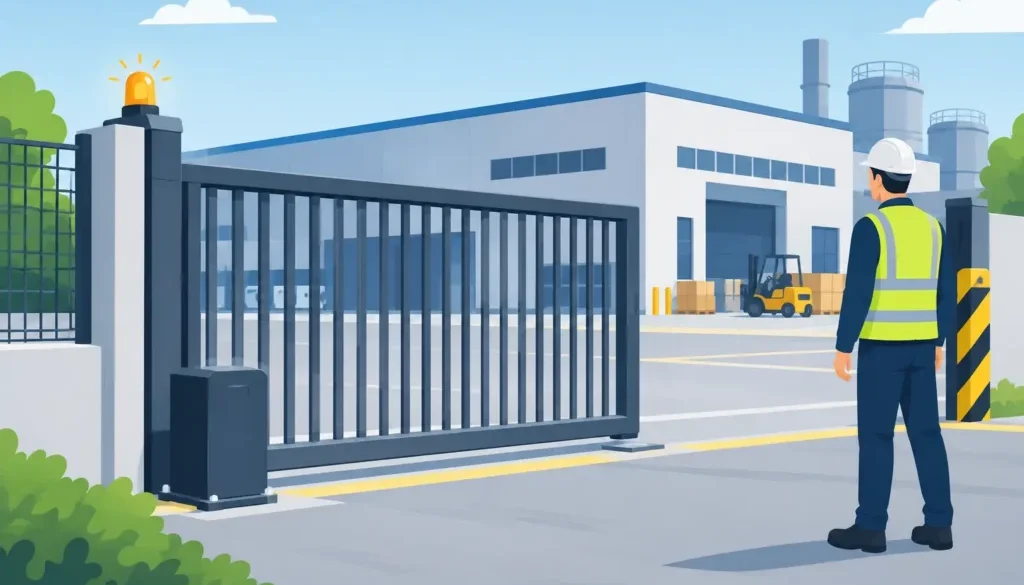
A well-designed automated gate system uses multiple layers of protection. Photo eyes can detect a vehicle or person in the gate’s path. Vehicle loops can help control opening and closing based on traffic movement. Edge sensors can help detect contact at defined pinch-point areas. Warning signs, visible markings, and appropriate controls help drivers and visitors understand where to stop and how to use the entrance.
These components must be installed in the right locations and tested as a system. A photo eye that is misaligned, blocked by snow, or mounted where it does not cover the true hazard area cannot provide reliable protection. The same applies to loops that fail to recognize certain vehicles or access controls that encourage drivers to stop in an unsafe location.
Protect Pedestrians Separately
One of the clearest industrial gate safety rules is to keep pedestrians out of the vehicle gate’s path. Employees, visitors, delivery drivers, and contractors should have a designated pedestrian entrance whenever possible.
A separate walk gate gives people a clear route into the property without asking them to pass through an automated vehicle opening. Use fencing, signs, and site layout to make the safe route obvious. If pedestrian traffic must cross near the gate, the area should be clearly defined, visible to drivers, and considered in the gate’s safety-device plan.
Do not allow people to ride, climb, hang from, or walk under a moving gate. This should be addressed during employee orientation and reinforced with signage near the entrance.
Eliminate Pinch Points and Unsafe Gaps
Gates create potential pinch, crush, and entrapment zones at posts, rollers, hinges, guide assemblies, and closing edges. Proper installation helps control these hazards through guarded hardware, suitable clearances, and fencing that prevents someone from reaching through into a moving area.
Pay close attention to the spaces beside the gate and between the gate and adjacent fence. Small gaps can become serious hazards if they allow a person to enter an area where the gate travels. Modifications made after installation, such as adding signs, conduit, landscaping, or storage near the gate, can also introduce problems. Keep the entire travel area clear.
Make Inspection Part of Facility Maintenance
Gate problems often announce themselves early. A gate may move more slowly than usual, make unusual noise, stop unevenly, or require repeated access-code attempts. These are not minor inconveniences to ignore. They are reasons to inspect the system before a complete failure creates a security gap or safety issue.
A facility manager or designated employee should visually check the gate area regularly, especially after storms, plowing, construction activity, or a vehicle impact. Look for loose hardware, damaged fencing, bent posts, worn rollers, obstructed photo eyes, exposed wiring, standing water, or debris in the travel path.
For higher-use entrances, establish a documented maintenance schedule with a qualified gate professional. Service should include testing the operator, safety devices, manual release, controls, hardware, chain or track condition where applicable, and the gate’s overall alignment. The exact schedule depends on gate type, cycle count, weather exposure, and site conditions. A high-traffic distribution yard requires more attention than a lightly used storage entrance.
Train the People Who Use the Gate
Even an expertly installed industrial gate can be misused. Employees should know who is authorized to operate the gate, how to use access controls, where to wait while entering, and what to do when the system does not operate normally.
Keep the instructions practical. Drivers should never force the gate, tailgate through a closing cycle, or attempt to repair an operator themselves. They should report a gate that reverses unexpectedly, fails to close, makes grinding noises, or shows visible damage. If a gate is not operating safely, restrict access and arrange service rather than relying on a temporary workaround.
Delivery drivers and contractors need clear direction as well. Posted instructions at the entrance can reduce confusion, but they should support – not replace – a site plan that makes traffic flow intuitive.
Plan for Emergency Access and Power Loss
An industrial gate must support security without delaying emergency response. Confirm that fire, police, ambulance, and authorized facility personnel have an approved method of entering when necessary. The right solution varies by property and may involve access credentials, emergency-release procedures, or coordination with local responders.
Power outages deserve similar attention. Know whether the gate operator includes battery backup, what functions remain available during an outage, and who is trained to use the manual release. The release mechanism should be protected from unauthorized use while remaining accessible to authorized personnel.
Do not wait for an emergency to discover that keys are missing, instructions are unclear, or a gate cannot be safely secured in its open position.
When to Call a Gate Professional
Industrial gates need professional attention after a collision, repeated operator faults, visible sagging, damaged safety devices, or a change in how the property is used. Expanding a loading area, adding truck traffic, resurfacing pavement, or changing access-control requirements can all affect whether the existing gate remains suitable.
Boulevard Fence helps Twin Cities property owners and managers evaluate industrial fencing, gates, and gate operators with a focus on dependable operation, durable materials, and site-specific safety. A thoughtful installation makes daily access easier to manage while protecting the people and property behind the fence.
A gate should feel uneventful when it is working correctly: vehicles move where they should, pedestrians have a clear route, and the entrance closes securely after use. Keeping it that way requires attention before problems turn into interruptions.