
A driveway gate should make arriving home or securing a property easier, not create another daily chore. When property owners ask how to automate driveway gate access, the answer is not simply to attach a motor. A dependable system starts with a properly built gate, the correct operator, and safety equipment designed for the way the entrance is actually used.
For Twin Cities homes, businesses, and industrial sites, the details matter even more. Snow, ice, wind, uneven ground, and frequent vehicle traffic can expose weak components quickly. Planning the complete system before installation helps protect your investment and delivers the security, convenience, and curb appeal an automated gate should provide.
Start With a Gate Built for Automation
An operator can only perform as well as the gate it moves. Before automating an existing driveway gate, inspect its posts, hinges, frame, rollers, track, and latch points. A gate that drags, sags, binds, or needs to be pushed into position manually is not ready for an operator.
For swing gates, strong hinge posts and a level gate frame are essential. The gate must travel freely through its full opening and closing path without rubbing the ground or catching on landscaping. A sliding gate needs a stable track or cantilever system, appropriate rollers, and enough clear space along the fence line for the gate to travel.
Weight and length also determine what type of operator is appropriate. A decorative residential gate may be relatively light, while a wide commercial steel gate can be heavy and used dozens or hundreds of times each day. Selecting an operator based on appearance or price alone often leads to premature wear and unreliable performance.
A professional site evaluation identifies whether the existing gate can be automated safely or whether reinforcement, repair, or replacement makes better long-term sense. This is especially valuable when the gate is older, oversized, or exposed to strong wind.
Choose the Right Type of Gate Operator
The first major decision is whether a swing or sliding system best suits the driveway. The right choice depends on available space, driveway grade, gate size, traffic volume, and the level of security required.
Swing gate operators
Swing operators open a gate inward or outward on hinges. They are common at residential properties because they can complement wood, ornamental, vinyl, and chain-link gate designs. Linear arm and articulated arm operators are often used for single or dual swing gates.
Swing gates require adequate clearance across the driveway. They are not always the best choice on a steep driveway, where the gate could strike the pavement or where snow accumulation regularly affects its travel path. The gate also needs room to open without blocking a vehicle lane or public right-of-way.
Sliding gate operators
Sliding gates move sideways along the fence line and are often a strong option for wider openings, sloped driveways, commercial entrances, and properties where a swinging gate would take up too much space. Chain-driven and rack-and-pinion systems are common, while cantilever gates avoid a ground track across the driveway.
A sliding system can provide excellent access control, but it needs sufficient side room for the gate to open fully. The operator must also be sized for the gate’s weight, length, and expected duty cycle. A busy apartment, warehouse, or contractor yard has different demands than a private home with a few vehicle trips per day.
Plan Power Before Installing the Operator
Every automated driveway gate needs a dependable power plan. Hardwired electric service is generally the most consistent option, particularly for larger gates and high-traffic commercial applications. It may require trenching, conduit, a dedicated circuit, and work coordinated with a qualified electrician.
Solar power can be a practical alternative where running electrical service is difficult or costly. It is best suited to locations with reliable sun exposure and an operator sized for the available solar capacity. Tree cover, northern winters, high cycle counts, and added accessories can affect solar performance, so the system should be designed around real conditions rather than ideal ones.
Battery backup is worth considering for either power option. An outage should not leave residents, employees, tenants, or service vehicles unable to enter or exit. Backup power also supports consistent operation during the weather events that tend to make controlled access most important.
Build Safety Into the System From the Beginning
Automated gates are powerful moving equipment, not just convenience features. They need properly placed safety devices that detect vehicles, people, pets, and obstructions. A safe installation accounts for every point where someone could be struck, trapped, or caught by the gate.
Photo eyes create an invisible beam across the opening. When that beam is interrupted, the gate should stop or reverse according to the system design. Vehicle exit loops can open the gate automatically for an authorized vehicle leaving the property, while safety loops help prevent the gate from closing on a vehicle in its path.
Edge sensors, warning signs, protective guards, and a clearly accessible manual release may also be needed. The exact equipment depends on the gate style and property use. A residential driveway has different risks than a busy commercial entrance, but safety should never be treated as an optional add-on.
Avoid using an automated gate as the only pedestrian entrance. A separate walk gate keeps people from trying to slip around, under, or through a moving vehicle gate. It is a simple design decision that improves both daily convenience and site safety.
Select Access Controls That Fit Daily Use
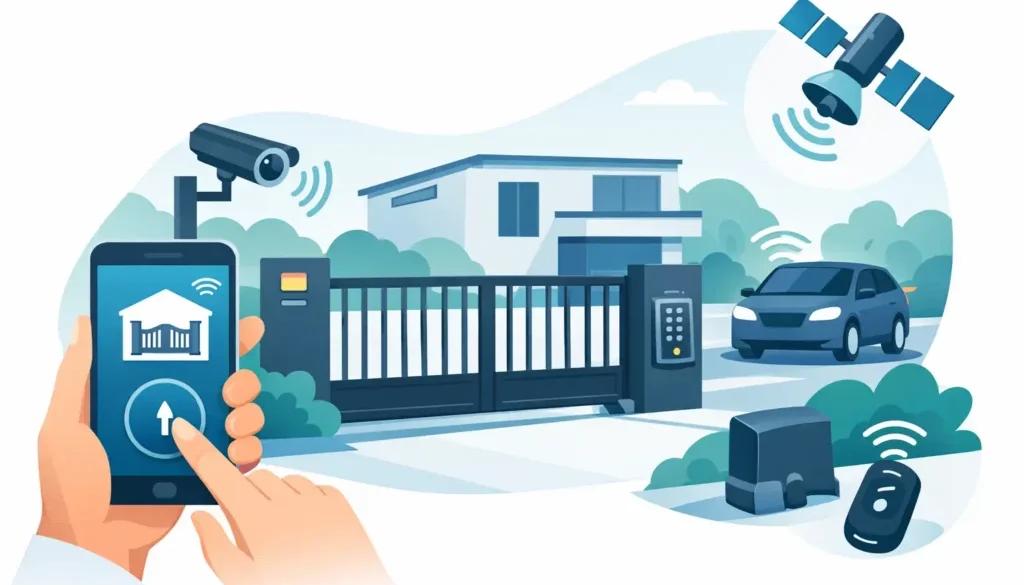
The operator moves the gate, but the access-control system determines who can use it. A basic residential setup may use vehicle remotes and a keypad. A property with deliveries, contractors, guests, or multiple users may benefit from a telephone entry system, video entry, key cards, or app-based controls.
The goal is to match the system to the property instead of adding technology that creates confusion. A homeowner may want a keypad for family and trusted visitors. A commercial property manager may need individual credentials that can be added or removed as staffing changes. An industrial site may need controlled entry, exit detection, and integration with established security procedures.
Think through common situations before selecting controls. Consider package deliveries, emergency access, snow removal crews, after-hours employees, garbage collection, and service vehicles. A well-planned system reduces workarounds such as leaving the gate open all day or sharing a single code with too many people.
Prepare for Twin Cities Weather and Maintenance
Minnesota weather is hard on exterior equipment. Freeze-thaw cycles can shift posts and pavement. Ice can interfere with tracks and gate travel. Wind can place additional stress on large solid-panel gates, while road salt and moisture can accelerate corrosion on exposed metal components.
Choose durable materials and protect electrical connections from moisture. Keep the gate path clear of snow, ice, gravel, branches, and debris. For sliding gates with a ground track, regular cleaning is particularly important. For swing gates, inspect hinges and verify that frost movement has not changed the gate alignment.
Routine service helps catch small issues before they disable the system. Check the gate’s travel, safety devices, hardware, chain or rack tension, batteries, and operator settings on a regular schedule. If the gate starts moving unevenly, makes new noises, reverses unexpectedly, or fails to close consistently, stop relying on it until the cause is identified.
Why Professional Installation Matters
Automating a driveway gate involves structural work, electrical planning, moving equipment, and safety requirements. A do-it-yourself operator kit may seem straightforward, but an incorrectly sized operator or poorly aligned gate can cause costly damage and create real safety concerns.
Professional installation brings the entire project together: gate construction, operator selection, concrete work, wiring coordination, safety devices, access controls, and final adjustment. It also allows the system to be designed for the property’s layout and expected traffic rather than forced into a one-size-fits-all package.
Boulevard Fence helps Twin Cities property owners create automated gate systems that combine dependable security with a clean, professional finish. Whether the project involves a private driveway, a managed property, or a secured business entrance, the right plan begins with a careful assessment of the gate, site, and daily access needs.
A well-built automated gate should feel simple to use because the complicated work was handled before it ever opened for the first time. Start with a gate that is ready for automation, choose equipment that fits the site, and give safety the same priority as convenience.


